Concert tickets are not cheap, and they are getting harder to buy at a reasonable price. Between dynamic pricing, resale markups, and service fees that can add 20 to 40 percent on top of the listed price, seeing your favorite artist live can feel like a financial event all on its own. The good news is that cheaper tickets do exist. They just require a little more strategy than clicking the first link you find.
This guide covers 10 practical ways to lower what you actually pay for concert tickets in 2026, whether you are shopping during the original sale or navigating the resale market after a show sells out.
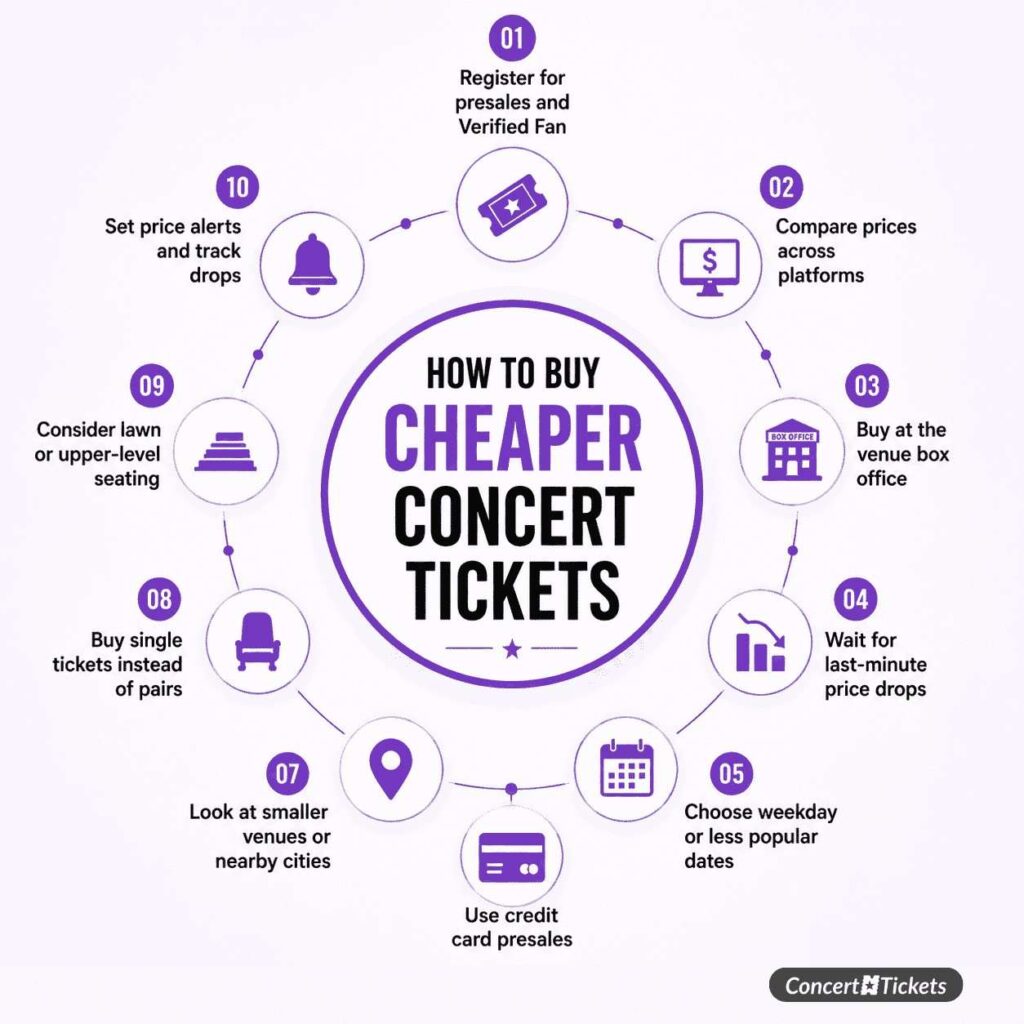
10 Ways to Find Cheaper Concert Tickets
Finding affordable concert tickets usually comes down to three things: timing, flexibility, and knowing which platforms to check. The cheapest ticket is rarely the first one you see, and the most expensive one is not always the best seat in the house.
Here is a quick overview of the strategies covered in this guide.
| Strategy | Best For | How It Helps |
|---|---|---|
| Register for presales and Verified Fan | Dedicated fans of specific artists | Access to face-value tickets before general sale |
| Compare prices across platforms | All buyers | Same seat can vary 20 to 40% between sites |
| Buy at the venue box office | Local fans near the venue | Avoids most online service fees |
| Wait for last-minute price drops | Flexible fans who can handle risk | Sellers drop prices in the final 48 hours |
| Choose weekday or less popular dates | Fans with flexible schedules | Lower demand means lower resale prices |
| Use credit card presales | Cardholders (Amex, Citi, Chase, Capital One) | Early access at face value |
| Look at smaller venues or nearby cities | Fans willing to travel or try new venues | Smaller capacity often means cheaper tickets |
| Buy single tickets instead of pairs | Solo concertgoers or flexible groups | Odd single seats are often priced lower |
| Consider lawn or upper-level seating | Budget-focused fans | Significant savings with a different perspective |
| Set price alerts and track drops | Patient buyers watching a specific show | Buy when prices dip instead of guessing |
How to Find Cheaper Concert Tickets (Explained)
Each of these strategies works differently depending on the artist, the venue, and how much flexibility you have. Some are best for fans who plan ahead. Others reward patience. A few only work if you are willing to make small compromises on seat location, date, or convenience.
1. Register for Presales and Verified Fan
Presales are the single best opportunity to buy concert tickets at face value before dynamic pricing and resale markups enter the picture. If you are not registering for presales, you are starting the process at a disadvantage.
Ticketmaster’s Verified Fan system is one of the most widely used presale formats in 2026. When a major tour is announced, fans can register through Ticketmaster, and a subset of registrants receive a unique presale code. The code is tied to your account and cannot be shared or transferred. Selection is based on a combination of factors including account history, streaming activity, and random selection.
A few things to keep in mind:
- Register as soon as the tour is announced. Registration windows often close 48 to 72 hours before the presale.
- Use a real carrier phone number on your Ticketmaster account, not a VoIP or Google Voice number. Ticketmaster sends SMS verification codes during checkout for high-demand events, and internet-based numbers frequently fail this step.
- Not everyone who registers will receive a code. If you land on the waitlist, keep checking your email. Sometimes additional codes are released if selected fans don’t use theirs.
Beyond Verified Fan, many artists run their own presales through mailing lists and fan clubs. Signing up for an artist’s email list before a tour is announced is one of the simplest ways to improve your chances.
One important note: presale access gives you earlier entry, not cheaper tickets. The prices are still face value, but face value before demand spikes is almost always better than what the resale market charges 48 hours later.
2. Compare Prices Across Multiple Platforms
The same ticket can cost dramatically different amounts depending on where you buy it. That sounds obvious, but most fans check one or two platforms and assume they are seeing the best price.
In 2026, the major resale platforms include StubHub, SeatGeek, Vivid Seats, TickPick, and Ticketmaster’s own resale marketplace. Each charges different fees, and those fees can swing the total cost by $30 to $60 or more on a single ticket.
Here is a rough breakdown of what you can expect:
| Platform | Typical Buyer Fees | Notable Feature |
|---|---|---|
| StubHub | 10 to 20% | Largest resale inventory, FanProtect guarantee |
| SeatGeek | 15 to 25% | Deal Score ratings, all-in pricing display |
| Vivid Seats | 15 to 30% | Rewards program for repeat buyers |
| TickPick | 0% buyer fees | Only major platform with no hidden buyer fees |
| Ticketmaster Resale | Varies | Integrated with original sale inventory |
The FTC’s all-in pricing rule, which took effect in May 2025, now requires ticket sellers to display the total price upfront, including all mandatory fees. This has made comparisons easier, but the rule controls disclosure, not the price itself. Platforms can still charge whatever they want. They just have to show you the full number from the start.
The practical move: open two or three platforms in separate tabs, sort by price, and compare the checkout totals before you buy. A ticket that looks cheaper on one platform may actually cost more once fees are factored in.
3. Buy at the Venue Box Office
This is one of the oldest strategies in the book, and it still works for fans who live close enough to make the trip. Buying tickets directly at the venue box office can help you skip most of the online service fees that inflate the final price.
When you buy through Ticketmaster or another online platform, you are typically paying a service fee, a facility fee, and sometimes an order processing fee. At the box office, many of these charges either shrink or disappear entirely because the transaction bypasses the online ticketing layer.
The catch is that box office availability is limited. Not every venue keeps a significant allocation for in-person sales, and with mobile ticketing now the standard delivery method, some box offices have reduced their hours or walk-up inventory. For smaller or mid-size venues, though, this strategy can still save you a noticeable amount per ticket.
If you are considering this route, call the venue ahead of time to confirm what is available and when their box office is open.
4. Wait for Last-Minute Price Drops
This one is a gamble, but it pays off more often than most people expect.
Resale ticket prices tend to follow a predictable pattern for many shows. Prices spike shortly after an event sells out, stay elevated for weeks or months, and then begin to drop as the concert date approaches. In the final 48 hours before showtime, sellers who have not moved their tickets face a choice: lower the price or eat the loss. Most choose to lower the price.
This strategy works best when:
- The show has not completely sold out
- There are many resale listings for the same event
- You live close to the venue and do not need to arrange travel
- You would be happy with almost any seat
It does not work well when demand is genuinely overwhelming, like a farewell tour, a one-night-only special, or an artist who rarely tours. For those shows, waiting too long can mean watching the prices climb instead of fall.
If you can handle the uncertainty, last-minute buying can sometimes get you into a show for significantly less than what fans paid months ago.
5. Choose Weekday or Less Popular Dates
Friday and Saturday shows almost always cost more because that is when most people can attend. If you are flexible enough to go on a Tuesday or Wednesday, you are competing against fewer buyers, and that difference in demand often shows up in the price.
This applies to both the original sale and the resale market. For artists playing multiple nights in the same city, the middle dates of a run tend to be cheaper than the opening or closing night. The first show carries the excitement of the tour arriving, the last show feels like a final chance, and everything in between is just a concert. That “just a concert” pricing can work in your favor.
The tradeoff is real. A Tuesday night show means getting home late on a work night, and for some fans, that alone is not worth the savings. But if you can make it work, weekday shows are one of the most reliable ways to pay less for the same artist and the same venue.
6. Use Credit Card Presales
American Express, Chase, Citi, and Capital One all run presale programs through Ticketmaster and Live Nation. If you have a card from one of these issuers, you may already have access to an early buying window that most fans do not even know about.
Credit card presales typically open after the artist presale and Verified Fan window but before the general on-sale. Prices are face value, and the inventory is often solid, especially for cardholders who act quickly.
A few things to know:
- You must complete the purchase with the same card type that unlocks the presale. If you enter with an Amex presale code, you need to pay with an Amex card.
- These presales do not eliminate fees. You still pay whatever service charges the platform applies. The advantage is early access to face-value pricing.
- Not every tour offers credit card presales, but the biggest tours almost always do.
For fans who already carry one of these cards, this is essentially free access to better inventory. If you are deciding between cards and attend concerts regularly, it is worth factoring presale access into your decision.
7. Look at Smaller Venues or Nearby Cities
A major arena show in a top-tier city will almost always cost more than the same tour playing a mid-size city 90 minutes away. Venue size, local demand, and market competition all influence ticket pricing, and smaller markets often come out ahead.
Even within the same metro area, prices can shift between venues. If an artist is playing three shows in your region, the show at the less famous venue in the less trendy neighborhood might be noticeably cheaper on the resale market simply because fewer people are fighting for those seats.
If you are willing to drive an extra hour or take a short trip, checking nearby cities can open up options that would not exist in your home market.
8. Buy Single Tickets Instead of Pairs
This one surprises people, but it makes sense once you think about how ticket inventory works.
Most buyers search for two or more seats together. That means pairs and groups sell first, and individual seats scattered throughout the venue are left behind. These orphaned singles are often priced lower because sellers know the pool of buyers willing to sit alone at a concert is smaller.
If you are going by yourself, this works in your favor. You may find a single seat in a premium section for less than a pair of tickets in a worse section.
If you are going with friends, you can sometimes save by buying singles separately and sitting in different spots. You will not be side by side during the show, but you will all be in the building, and you can meet up before and after. For fans whose main goal is simply getting through the door, this can be a practical workaround when prices for adjacent seats are out of reach.
9. Consider Lawn or Upper-Level Seating
The cheapest seats are not always bad seats.
For outdoor amphitheater shows, lawn seating is often the most affordable option by a wide margin. You are farther from the stage, but lawn sections at many venues have their own atmosphere. The crowd tends to be more relaxed, there is more space to move, and modern video screens and sound systems mean you can still see and hear the show clearly.
For indoor arenas, upper-level seats carry a similar dynamic. They cost less because they are farther from the action, but the view from the upper bowl of a well-designed arena can still be excellent, especially if the production includes large screens and strong lighting.
The question to ask yourself is whether you are paying for proximity to the stage or for the experience of being at the concert. If the answer is the experience, the cheaper seats may give you everything you need.
10. Set Price Alerts and Track Drops
If you have a specific show in mind but the current prices feel too high, setting a price alert is a smarter approach than refreshing the page every few hours and hoping for the best.
Several platforms let you set a target price and receive a notification when a listing drops into your range. SeatGeek’s Deal Score feature also rates each listing on a scale from 1 to 100, which can help you quickly identify when a ticket is priced below market value.
Price tracking works especially well for tours with high demand and lots of resale activity. When thousands of listings are competing for buyers, prices shift daily. A ticket that costs $180 today might drop to $140 next week if a new batch of listings hits the market.
The key is setting a realistic target. If the cheapest ticket in the building is $120 and you set your alert at $60, you will probably never hear from it. But if you set it at $100 and a seller decides to cut their price a few days before the show, you will be ready.
Common Mistakes While Buying Tickets That Cost Fans Money
A few habits consistently lead to overpaying:
- Buying from the first platform you check. The same seat at the same show can cost 20 to 40 percent more on one platform compared to another. Always compare.
- Ignoring fees until checkout. Even with the FTC’s all-in pricing rule now in effect, not every platform displays fees the same way. Look at the total, not the listed price.
- Panic-buying after a sellout. Resale prices spike immediately after a show sells out, often to their highest point. If you can wait even a few weeks, prices frequently come back down.
- Skipping presale registration. Many fans do not bother registering for Verified Fan or signing up for artist mailing lists. Those extra five minutes of effort can be the difference between face-value tickets and resale markup.
- Assuming expensive tickets are better. A $400 VIP package that mostly includes early entry and a merchandise bundle may not be a better experience than a well-located $120 seat. Evaluate what you are actually getting before paying the premium.
Concerts happening that you can check out:
Conclusion
Finding cheaper concert tickets is not about knowing one secret trick. It is about giving yourself more options. Registering for presales puts you in the room before resale markups take hold. Comparing platforms keeps you from overpaying for the same seat. Being flexible on dates, seats, or cities can quietly shave off more than you would expect.
The riskier strategies, like waiting for last-minute drops, can lead to the best deals, but they are not for every fan or every show. If you are traveling for a concert, planning around it, or simply cannot imagine missing it, paying a little more for a confirmed ticket is a perfectly reasonable choice. Not every concert is worth gambling on.
The goal is not to find the absolute cheapest ticket at all costs. It is to find a ticket you can afford for a show you want to see, without the buying process itself becoming the stressful part of the experience.
FAQs
The savings depend on the artist, the show, and the strategy. Comparing platforms alone can save you 20 to 40 percent on the same seat. Buying at the venue box office can eliminate $15 to $50 in service fees per ticket. Waiting for last-minute drops can occasionally cut resale prices in half, though this varies widely.
For a fan buying two tickets to a major arena show, using even two or three of these strategies together can realistically save $50 to $150 or more on the total purchase.
Yes, as long as you buy from established platforms with buyer protection guarantees. StubHub’s FanProtect, SeatGeek’s Buyer Guarantee, and similar programs cover you if tickets are invalid, do not arrive, or if the event is canceled. Avoid buying tickets through social media, direct cash deals, or unverified sellers. Most venues now use rotating QR codes and mobile-only delivery, which makes it much harder for fraudulent tickets to work at the door.
Neither option is universally better. Buying early during the presale or general on-sale gives you the best selection at face value and removes the stress of waiting. Waiting for resale prices to drop can save you money, but it comes with the risk that prices rise instead, or that the show sells out completely. For concerts you absolutely cannot miss, buying early is the safer choice. For shows you would like to attend but are not committed to at any price, patience can pay off.
Many do, but the availability varies by venue. Larger arenas sometimes reserve a limited allocation for walk-up sales, while smaller and mid-size venues may have more consistent box office inventory. Mobile ticketing has reduced the role of the box office at some venues, so it is worth calling ahead to confirm what is available and whether in-person purchases still avoid online fees.
The FTC’s Rule on Unfair or Deceptive Fees, which took effect on May 12, 2025, requires all live-event ticket sellers to display the total price of a ticket upfront, including all mandatory fees. This applies to both primary sellers like Ticketmaster and resale platforms like StubHub and SeatGeek. The rule improves transparency, but it does not cap or reduce fees. Sellers can still charge whatever they choose. The difference is that you now see the full price before you start the checkout process rather than watching it climb at the end.